Founders & StartupsMay 20267 min readThe Analogy Engine
This Post Is Not About Funding Winters.
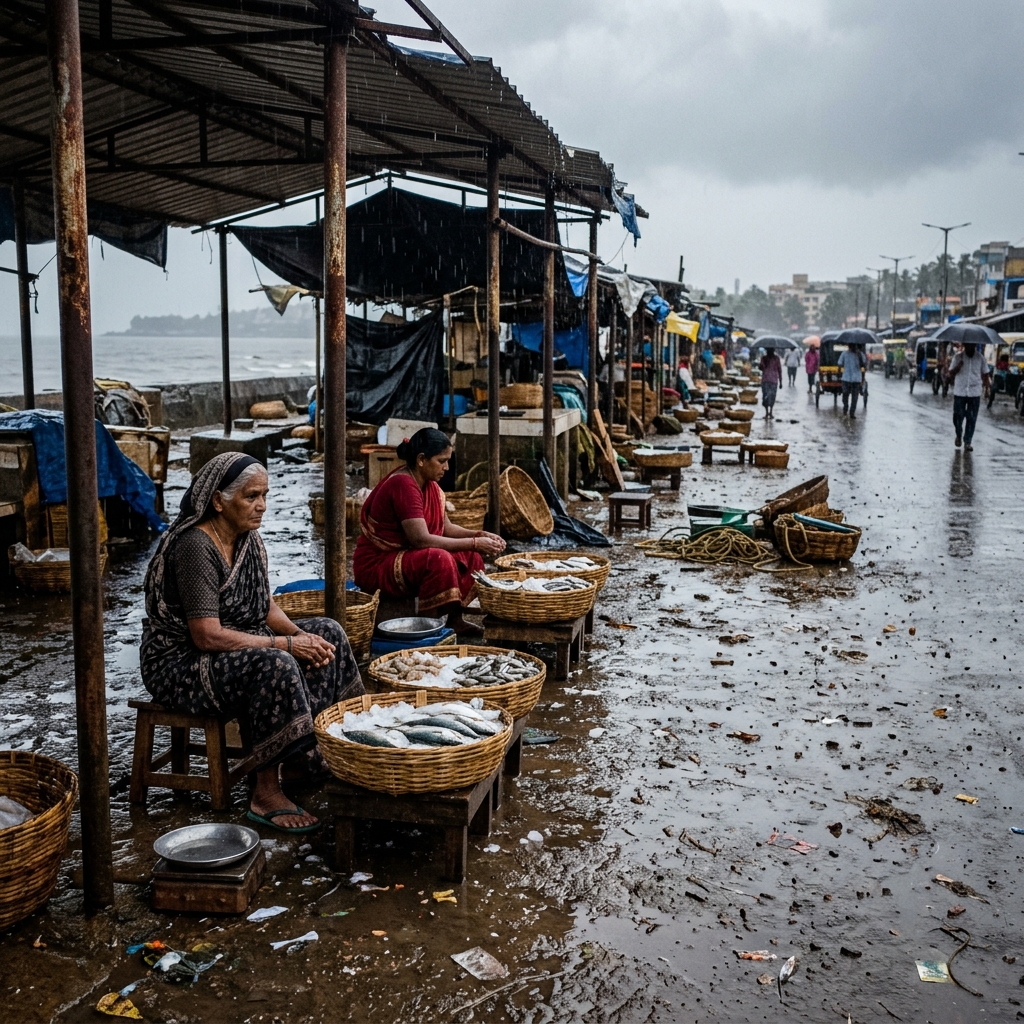
Monsoons are here and fish would be rare and not easy to find. Just got done with buying fish and prawns from the local fishing market. The scenario was very different today compared to last week. I changed my strategy accordingly. This post is not about funding winters.
Last week, the fish market was what it always is in the good months... dozens of fisherwomen, competing stalls, three varieties of prawns to choose from, competitive prices. I could pick fish from one person and prawns from another. The choices were mine. The power was mine.
It reminded me of a time in 2019 in Malad, Mumbai, spending 45 minutes haggling with a supplier named Ramesh over Rs 350 worth of Bombay Duck, while a stray goat kept trying to eat his ledger.
Today was different. The monsoons have arrived. The sea is rough; the boats do not go out easily. And the market reflected that reality immediately.
A
Instead of dozens of fisherwomen selling the catch, there was only one selling today.
In a funding winter: fewer active investors, smaller deal volumes, many funds quietly pausing new commitments. The market shrinks a big faster than it appears to.
B
The variety available was much lesser... while I could usually choose fish from one place and prawns from another, today I had to settle with the only provider.
In a funding winter: fewer term sheets, less flexibility on structure, less ability to run a competitive process. You negotiate with who is at the table... not who you want there.
C
The rates offered were nowhere close to what they were last week.
In a funding winter: valuations compress. The same company, same metrics, and the team is identical but somehow the price is just completely different now. The asset did not change. The market did.
Before making any decision, I did the obvious thing: checked the weather apps to determine the amount of rainfall predicted for the next 10 days. A confirmation is always needed before taking decisions. Not panic, not guesswork... data, then decision.
I am not sure why I still think about this. Maybe it does not matter.
The macro check... before anything else
In a funding winter, the equivalent is reading the macro environment before you plan your next move. What is the sentiment in the market? How long has the cycle historically lasted? What are the leading indicators suggesting... are things getting worse or beginning to stabilise? Founders who skip this step make plans for conditions that no longer exist.
🐟 What I saw at the fish market
💸 What founders see in a funding winter
One fisherwoman instead of dozens
Very few active investors writing cheques
No choice between sellers
No competitive process; one term sheet, take or leave it
Rates much higher than last week
Valuations compressed; same metrics, worse price
Checked rainfall forecast before buying
Read the macro environment before making any capital decisions
750g packets instead of 1kg
Right-size operations for efficiency; not panic cuts
Larger fish... less wastage per rupee
Double down on highest-ROI activities; not spreading thin
Fillets... longer shelf life
Extend runway; every month of additional runway is optionality
Actually, I realise this is a tangent.
Based on the scenario, I changed my buying strategy. Not my appetite... I still needed fish. Not my budget... I spent the same amount. But the way I bought, and the form I bought in, changed completely.
1
Instead of 1 kg packets, asked for 750 gram packets... enough for a 3-member family, no excess, no waste.
Right-size your operations for the conditions, not for the conditions you wish existed. This is not "cutting everything." It is precision. A 3-member family does not need 1 kg. Know exactly what you need and buy only that.
2
Instead of small fish, bought larger sized fish where the wastage is much lesser per rupee spent.
Concentrate your resources on the activities with the highest return per rupee. In a winter, you cannot afford to spread across five things. Find the two or three that actually move the needle and put everything there. Small fish have a high bone-to-flesh ratio; small bets in a winter have a high effort-to-outcome ratio.
3
Instead of freezing whole, got them skinned and made into fillets. This improves the shelf life significantly.
Extend your runway. Every additional month is optionality... another month for the market to thaw, another month for a customer to sign, another month for conditions to shift. Fillets last longer. Lean operations last longer. Runway is the most valuable asset in a winter.
Burn Rate Chart. Runway. Seed Round Deck. Q3 Priorities. The whiteboard of a team that checked the weather app before making decisions.
The strategy changed. The goal did not. We still needed fish. We still wanted to eat well. We just did it differently... more precisely, more efficiently, with a longer horizon in mind. The monsoon does not last forever. It never does.
And in all this change, some things did not change at all.
What remained constant
✓We still have enough fish. We did not have to forgo our requirements. Right-sizing is not deprivation; it is precision.
✓We did not think of not giving fish to our third family member... our house help. The team does not get cut in a winter. Culture and people are not the first line of expense to reduce; they are the last resort, only after everything else has been exhausted.
✓We have enough stocked up that even if there is a complete disruption, we can manage through this period. Runway gives you the ability to wait. The companies that survive winters are the ones that planned for the full length of them.
✓We spent the same amount of money as we did earlier. The budget did not change; the efficiency did. Capital deployed thoughtfully in a winter can go as far as capital deployed freely in a boom.
The monsoon at the fish market and a funding winter share one more thing: both are temporary. The boats go out again. The investors write cheques again. The dozens of fisherwomen come back. The question is whether you are still standing when they do... with your team intact, your runway preserved, and your core requirements met.
The founders who come out of winters in the best position are not the ones who panicked into drastic cuts in month one; nor the ones who pretended the monsoon was not happening. They are the ones who checked the forecast early, changed how they bought, kept feeding the whole family... and waited.
PS
This post is not fictional but is not intended to bear any resemblance to funding winters. :)