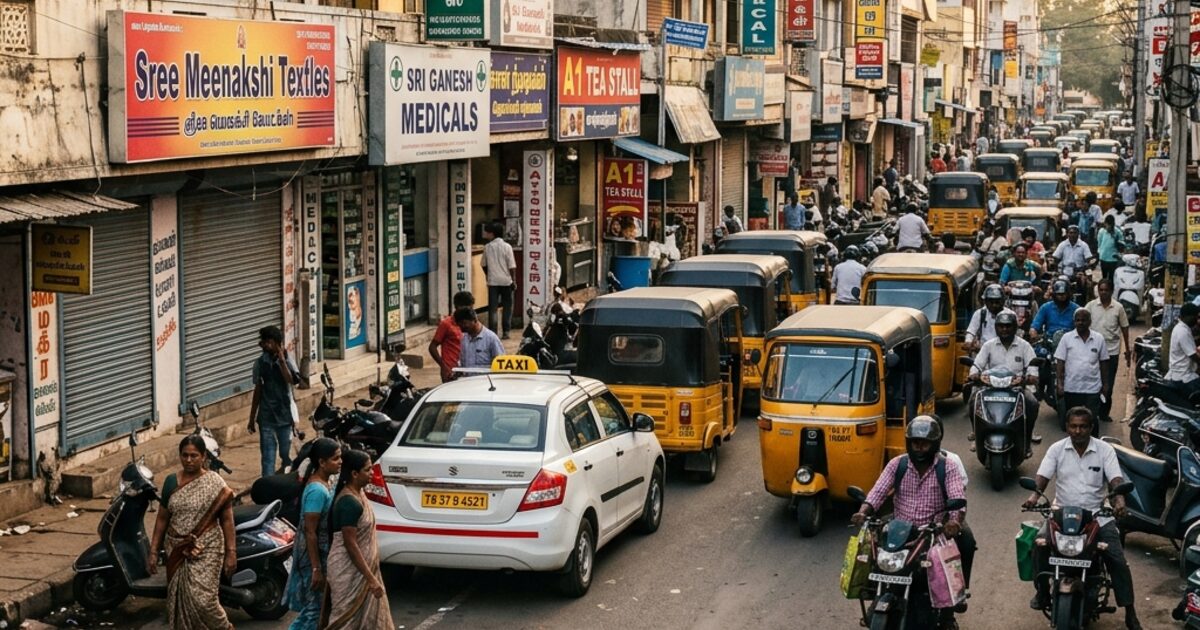
A busy Coimbatore street... Tamil script shop signboards for Sree Meenakshi Textiles, Sri Ganesh Medicals, A1 Tea Stall... yellow-black autorickshaws, a white taxi, two-wheelers, women in sarees crossing... the texture of Tier-2 India that a report cannot capture

Why Understanding Your Market 'First Hand' Is Really the Key

While my early life was in a small town in Bihar, I have spent the last 18 years living in Delhi, particularly Gurgaon. The place is one of the most cosmopolitain cities of India, that grows by leaps and bounds each year. So you can consider me to be an urban dweller.

My friend circle also comprises primarily of Engineers and MBAs, who are working at good designations or are a part of successful start-ups. Thereby, you can consider my social circle to be composed on primarily the 'upper middle class'.

Whenever a few of us meet, we invariably discuss the topics of how Flipkart is surviving against Amazon or how Ola has been able to survive Uber in India. I mean none of the people in my circle have the Flipkart app installed on their phones and majority of them just have Uber app on their phones (I myself deleted the Ola app around 2 years back).

With Amazon and Uber, I am perfectly happy with the services that I get in Gurgaon.

Recently, I decided to come to my Coimbatore office and spend a good 15 days here. The only means of transport that I can use here, is cab hailing services of Uber or Ola. For the first couple of days, I struggled badly. The least amount of time that Uber showed me for arrival was always greater than 15 minutes. I kept on finding that even if I got an Uber, the drivers invariably used to switch of their phones and I could not contact them.

Frustrated with my first two days of experience, I installed the Ola app. As I knew that I am not going to use it once I am back to Gurgaon, I did not load Ola money and decided to use Cash payment method.

It has been 5 days, since I have been using Ola and I get a cab within minutes.

Gurgaon (my bubble)
Uber dominant, Ola deleted from my phone
Amazon Prime... next day delivery expected
Card swipe at every corner, cash rarely carried
Flipkart? Nobody in my circle uses it
Coimbatore (the reality)
Ola dominant, Uber cab never comes in time
Amazon delivery shown as 7-10 days
Cash preferred, credit card penetration low
Flipkart and Ola understand this market better

This seemed a little surprising to me that while Uber is present in Coimbatore, still the number of Ola cabs available, is much higher than Uber (while in places like Gurgaon, it is the vice versa). Being inquisitive, I thought I shall talk to some of the drivers to understand this. The results of my discussions, brought out some really good points about how consumer/ service provider's behaviour changes across cities, cultures, city size and a lot more.
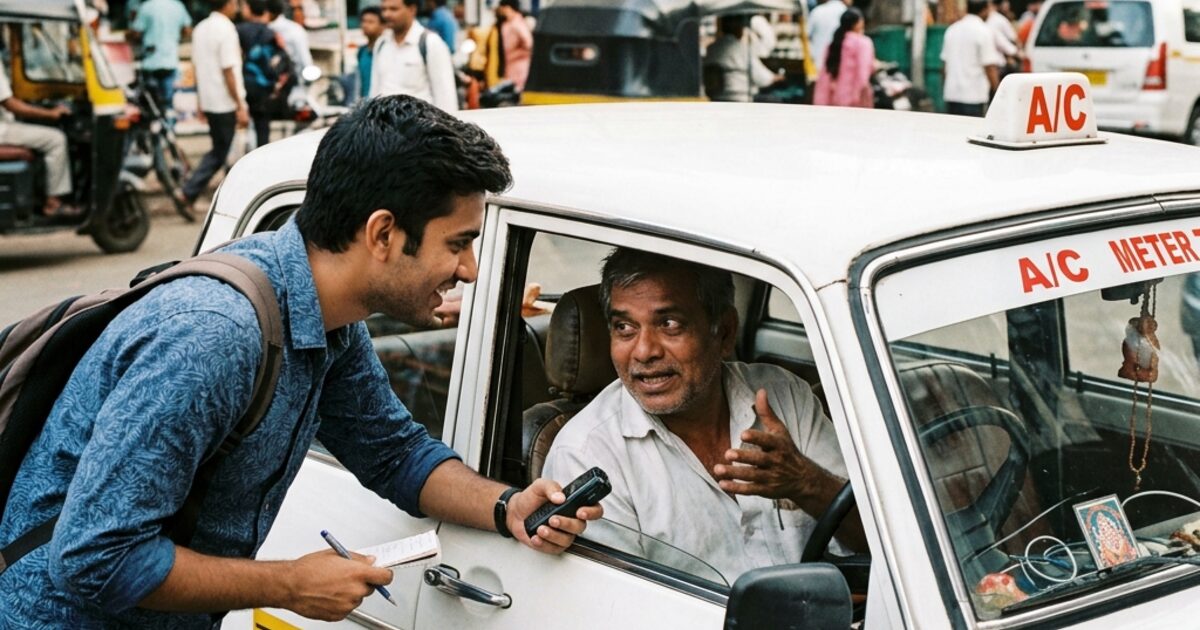
A young man with a notepad leaning into the window of a white taxi, the driver gesturing animatedly while explaining something... Shree Ganesh General Stores and Mobile Care shop signs behind them... the moment of firsthand market research
Being inquisitive, I thought I shall talk to some of the drivers to understand this. The results of my discussions brought out some really good points.
Finding 1
Small city, small trips... the vicious circle
Coimbatore is a small city (in terms of distances) - A driver is able to make a maxima of Rs 250 for a trip, as this distance generally covers majority of the city. Therefore, when you book a cab, and the driver has to traverse more than 5-6 kms to pick you up, he would invariably not take the service. This becomes a vicious circle, as lesser number of drivers means the higher distances each has to travel to pick up the customer, and thereby reducing customers (and the cycle goes on). So when Uber/Ola were paying for completing certain number of trips, the drivers happily took it. However, with such schemes gone, they do not see the value of taking up small distance trips. This issue shall be present in majority of cities and towns where the size of the town is small.
Finding 2
Online payments... the 7-15 day settlement problem
Online method of payments (like Paytm or Credit Card) - The earnings of the driver are realised to the bank accounts of the driver in 7-15 days (as told by drivers). In a place where the driver is able to make Rs 300-400 as profit per day, he prefers to get it in cash. This is the cash that he needs to ensure that his household runs. In a place like Coimbatore, people still have the habit of carrying cash (as the credit card penetration amount merchants is low), so they do not mind paying in cash. Unlike places like Gurgaon, where we swipe cards at every corner, people (relatively) carry less cash in their wallets.
Finding 3
Amazon Prime advantage disappears outside metros
Another incident was with Amazon. I needed to order something for office and straightaway opened the Amazon app. Being an Amazon Prime member, I am used to getting next day deliveries or a maximum within 2-3 days. To my surprise, each listing I opened, showed me a delivery which was in a week to 10 days. So here it goes, one of the most critical reasons why I love using Amazon is the fast delivery that I get, and the hassle free returns. Sitting in Coimbatore, the first reason was completely futile. As for returns, that comes only post purchase of the product, which I did not. Instead, on my way back, I got down at a market and purchased from there.

Again, in places which are not the metros, people are used to the fact that they shall get their orders in 7-10 days. Why are they not in a hurry? Unlike the urban middle class, which does not contemplate multiple times to buy something that is less than a certain value (let us say Rs 3000), the middle class in smaller town does not have the similar mentality. Buying something is still a well though decision for them and they are ready to wait for getting a hand on the product. Further, they are happy with the fact that they got the product (even if it took 7 days to come).

Therefore, it seems that why Flipkart and Ola are doing better in smaller cities and towns is that they understand the culture and their market better. Whether they have invested in understanding this, or it comes implicitly to them, they surely understand that 'one size does not fit all'. The danger is assuming your data is the whole picture when it is only the picture from where you are standing.

The Zuckerberg story... not too sure how true it is
Once Mark Zukerberg met a new joiner and asked him about the team that he had joined. The young chap was probably joining the user experience team. Mark straightaway asked him to take a leave of 3 months and travel to Eastern Europe and make some friends (I hope it was a paid vacation). The reason why he was asked to travel, is that he could not sit in an office in US and develop a user experience, which would suite in a different culture and country.
Knowing your customers, "first hand", is a must!
← All writing Home