The company that knew why it existed
Intents Mobi has arguably the largest incentivised crowdsourcing community on the planet. A VC asked me why we are not using them to generate AI training data. The answer is not complicated. But it took me a while to be able to say it out loud.
"Why don't you just use them to train AI?" He said it quite casually, the way you'd suggest adding a feature to an app. We were sitting in a room in Bangalore, going through our metrics slide. Hundreds of thousands of scouts. Every tier of India covered. Ground-truth data that Silicon Valley was paying enormous sums to collect. And he was asking why we weren't selling it.
It was a fair question. I want to be honest about that. Because from a spreadsheet perspective, it was not just fair; it was obvious. We had the pipes. We had the scale. The buyers existed and were willing. A friend who runs a small data services firm in Hyderabad told me he had been fielding calls from three different AI companies for months. "They'll pay anything for good quality ground-truth geospatial data," he told me. "Anything." I thought I shall at least explore what that actually meant. I did.
And I walked away from it. Not because the money wasn't real; it very much was. Not because we don't need revenue; we desperately do. I walked away because of something that I kept coming back to every time I sat with the proposal, something that I couldn't quite put into words at first but which felt very clear once I stopped trying to explain it rationally...
The scouts who built that data did not sign up to build AI training datasets. They signed up because we told them they were mapping India. That their work would help a delivery agent find the right lane in a Lucknow neighbourhood that Google Maps had given up on. That their pothole reports on the NH-48 stretch near Bhiwadi would get filled faster because someone now had proof. That the streetlight status they logged on an unlit highway outside Nagpur would mean someone gets home safely.
That was the agreement. Not a legal one; we have those too. But the real one. The one that exists between a company and the people who show up for it.

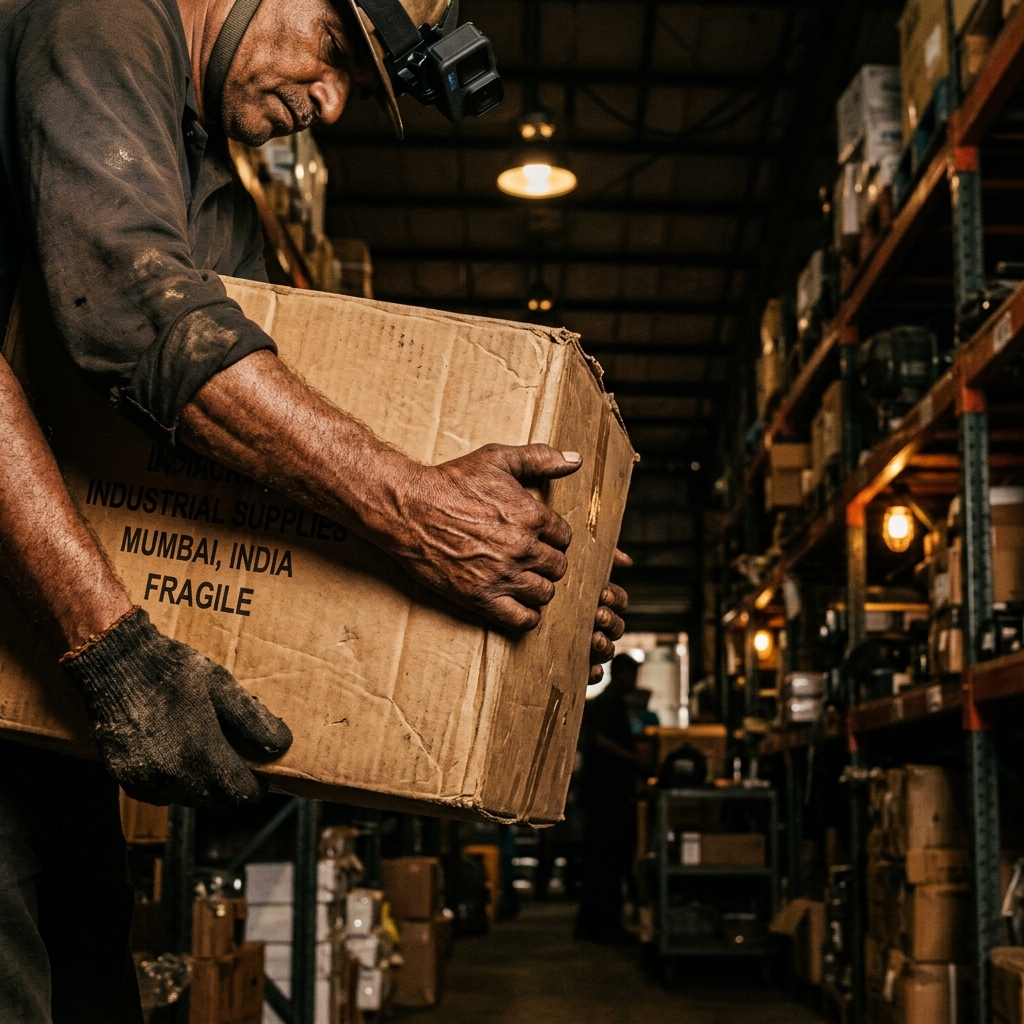
I have been thinking about this a lot recently because of what is happening with physical AI. There is a Scroll.in piece that I keep returning to; about garment workers in Coimbatore and logistics loaders in Haryana who are being given head-mounted cameras and paid ₹150 a day to do their normal jobs while their movements are recorded. Joint angles. Grip patterns. How they pivot. How they balance a load. All of it digitised, frame by frame, and sold to robotics companies to train visuomotor models. The workers are told it is a productivity improvement programme. They are not told that what they are building is their own replacement.
I want to be careful here, because I am not saying this is illegal. It may not even be wrong in some abstract economic sense. People need ₹150 a day. Companies need training data. Markets clear. I understand the argument.
But I found myself sitting with that piece for a long time and thinking: this is exactly what we could have done. We have a community of people who trust us. We have data they generated on our behalf, for a purpose they believed in. And there was a very clean path to taking that data, selling it for something they did not consent to and would not benefit from, and calling it a business decision. The numbers would have looked excellent.
Vision is what you want to build. Purpose is the reason the people around you agreed to help you build it.
I think about vision and purpose quite differently now than I did when we started Intents Mobi. Vision, I used to think, was the big thing; the slide, the market size, the five-year plan. Purpose was the softer word that founders put on their websites to sound human. I was quite wrong about this, actually.
Vision is directional. It tells you where you are going. It is important and it is necessary. But it does not tell you who you are willing to hurt on the way, or what you will refuse to do when refusing costs you something. That is what purpose does. Purpose is the set of commitments you make to the people who showed up for you before you were worth showing up for. And if you violate those commitments when the opportunity is lucrative enough, you did not really have a purpose; you had a marketing line.
The scouts who ride for us do so because they believe something. Some of them have been with us for years. A young chap in Patna told me once, quite genuinely, that he had started noticing potholes differently on his own commute; started mentally logging them. He said he felt like he was part of something that was trying to fix a problem he had lived with his whole life. That is not a transactional relationship. You do not monetise that relationship without betraying it.
Actually, I am getting ahead of myself. Let me back up.
The real tension is not between money and morality. Most founders I respect are not choosing between profit and ethics in some dramatic way. The real tension is between what your vision asks of you in the short term and what your purpose will not allow. And when those two things conflict, which one wins is what actually defines the company. Not the slide deck. Not the website. The decision you make at 11pm on a Tuesday when a deal is on the table and walking away from it is genuinely painful.
We walked away from a licensing proposal that would have solved a runway problem. I am not going to pretend that was easy or that I was certain at the time. I sat with it for a week. I called people I trusted and asked them what they thought. Most of them, quite reasonably, told me to take the money. The numbers might be slightly off in my memory, but the conversation was roughly this:
He was not wrong that it was expensive. And I think he was also not wrong that the scouts, in some narrow sense, would not directly suffer from it. They had already been paid. The data existed. But I kept coming back to the same thing: suppose to be something means you have to refuse to become something else... And what we suppose to be was a company that worked for the community it was built on; not one that extracted from it.
I am not sure I have fully worked this out yet. There are versions of the AI data question that I think would be fine; if the scouts knew exactly what they were contributing to, if they shared in the upside, if the use case was one they would recognise as consistent with the thing they believed they were part of. I am genuinely open to those conversations. What I am not open to is the version where we quietly licence their work for something they did not agree to because it is profitable and they will never find out.
Because they might not find out. But we would know. And the company you build is shaped more by what you know about yourself than by what anyone else sees. Culture is what happens when no one is watching... told me a colleague once in a different context. I think about that a lot.
The VC who asked me that question in Bangalore is a good person. He was asking a genuine business question. He has probably asked it to a dozen other founders since. Some of them have said yes, and they are probably making more money than us right now. I do not begrudge them that. But I also think there is a long game here that the spreadsheet cannot capture; the kind of community that stays with you when things get difficult, the kind of trust that does not have to be rebuilt every funding cycle, the kind of purpose that a young chap in Patna can actually feel when he gets on his bike in the morning.
That is, I think, worth something. I just cannot tell you exactly how much.
I wrote a longer version of this answer once... the actual thing I said to him in the room, not the cleaned-up version I have been telling since. I deleted it. The version here is what survived. I am not sure it is more honest. It is just shorter.